
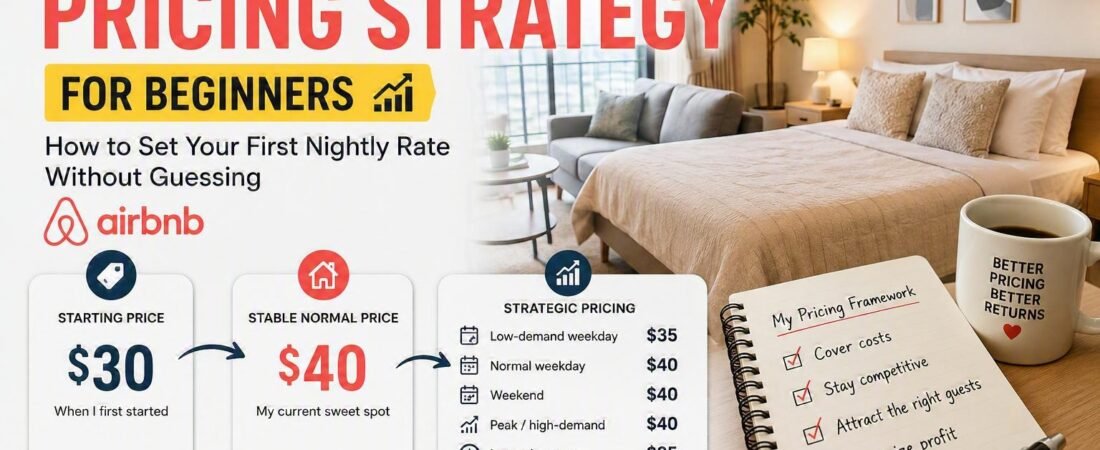
Airbnb pricing for beginners
Airbnb Pricing Strategy for Beginners: How to Set Your First Nightly Rate Without Guessing
Your first Airbnb price should help you get bookings without trapping your listing as the cheapest option in the market. This guide shows you how to set a beginner-friendly nightly rate, compare nearby listings, handle cleaning costs, use discounts carefully, and know when to raise your price.
Quick answer: how should a beginner set their first Airbnb price?
A beginner Airbnb host should start by checking similar listings nearby, estimating real costs, choosing a temporary launch price, and reviewing results after the first few bookings. Your first nightly rate should usually be competitive enough to attract early bookings and reviews, but not so low that it attracts bad-fit guests, creates too much turnover work, or ignores cleaning, supplies, utilities, platform fees, and maintenance days.
A practical beginner approach is to set a lower launch price for your first few stays, then raise toward your normal target price once your listing has reviews, clearer demand, and a better understanding of your real guest type.
Your first Airbnb price is a test, not your forever price
One of the biggest mistakes new hosts make is treating the first nightly rate like a permanent decision. It is not. Your first price is only your starting point.
When your listing is brand new, guests cannot rely on reviews yet. They are comparing your photos, location, amenities, house rules, cancellation policy, total price, and gut feeling. A slightly lower launch price can help you get those first bookings and reviews faster, but it should have a purpose.
Real host note
When I first launched my one-bedroom condo, I started at around $30 per night. The goal was not to make that my permanent price. It was a launch price to help the listing get early bookings, reviews, and traction. Once the listing became more stable, I moved closer to my normal price of around $40 per night.
The lesson is not “be the cheapest.” The lesson is to use a temporary launch price with a clear plan to adjust later. If you want the full beginner hosting roadmap before pricing your first listing, start with our complete guide on how to become an Airbnb host.
What your nightly rate needs to cover
Your Airbnb price is not just rent divided by nights. A short-term rental has costs that long-term rentals do not always have, especially if you are turning the property over every few days.
Before you choose a number, list the real costs behind each booking.
Direct stay costs
- Cleaning or cleaner payment
- Laundry
- Toiletries and supplies
- Coffee, tea, water, snacks, or welcome items
- Electricity, water, internet, and streaming services
- Platform fees or commission structure
Hidden operating costs
- Replacement towels and linens
- Small repairs and maintenance
- Wear and tear on furniture and appliances
- Time spent coordinating guests and cleaners
- Blocked dates for maintenance or inspection
- Discounts, promos, and platform-specific pricing adjustments
This is why beginners should not copy the cheapest listing nearby without checking what that listing includes. A low nightly rate can look attractive, but if it does not cover your real costs, you may end up busy without being profitable.
For the setup items that need to be ready before you publish, use our Airbnb listing setup checklist for beginners.
How to compare similar Airbnb listings before setting your price
Do not compare your listing to every property in your city. Compare it to listings that a guest would realistically choose instead of yours.
Start with listings that match your property type
If you host a one-bedroom condo, compare it with other one-bedroom condos first. If you host a family vacation home, compare it with similar homes that sleep the same number of people. A beautiful villa and a compact city studio are not competing for the same guest, even if they are in the same general area.
Compare total value, not just nightly price
When I check competitors, I look at photos, reviews, parking, price, and rating. Those five things tell you a lot about how guests will judge your listing.
| What to compare | Why it matters | Beginner pricing lesson |
|---|---|---|
| Photos | Guests often decide based on photos before reading everything else. | Better photos can support a higher rate than a poorly presented similar unit. |
| Reviews | Listings with many strong reviews feel safer to guests. | New listings may need a temporary launch price until reviews build trust. |
| Parking | Free or convenient parking can be a major value driver. | Do not price like a no-parking listing if you offer free parking. |
| Rating | Guests use ratings as a shortcut for quality and reliability. | A strong rating can help you move away from launch pricing. |
| Total price | Guests compare the final amount, not only the base nightly rate. | Cleaning fees, taxes, platform fees, and discounts affect conversion. |
Also check how each listing communicates check-in, house rules, amenities, and guest expectations. A smooth arrival experience can improve perceived value, especially if your property has parking, building access, front desk instructions, or self check-in. For that part, see our guide on Airbnb check-in instructions.
How to choose your Airbnb launch price
Your launch price should be low enough to help a new listing compete, but high enough to filter for guests who respect the property and understand the value of the stay.
A practical way to choose your launch price is:
- Find 5 to 10 similar listings nearby. Focus on same property type, guest capacity, location, parking, rating, and photos.
- Check their visible nightly rates and total prices. Look at weekdays, weekends, and near-term dates.
- Remove listings that are clearly not comparable. Do not compare your finished condo to a bare unit, or your compact studio to a luxury penthouse.
- Pick a launch price slightly below your true target range. This gives guests a reason to take a chance on a new listing.
- Set a review date. After the first few bookings, review your occupancy, guest quality, reviews, and workload.
Example launch pricing path
For my own one-bedroom condo, I started around $30 per night to get early bookings and reviews. Once the listing became more stable, I moved closer to around $40 per night as the normal price.
That kind of adjustment matters. The launch price helped create momentum, but the stable price better matched the value of the property and the type of guests I wanted to host.
Do not leave your listing at launch pricing forever. If your calendar fills too quickly, if guests are asking for too much, or if the workload no longer makes sense, your price may be too low.
When to raise your nightly rate
Raise your Airbnb price when the listing gives guests more confidence than it did at launch. That confidence can come from reviews, better photos, smoother operations, clearer rules, better amenities, or a more polished guest experience.
Signs you may be ready to raise your price
- You have several positive reviews.
- Your calendar is filling faster than expected.
- You keep receiving many low-priced bookings with lots of requests.
- Your competitors with similar quality are priced higher.
- You added meaningful value, such as better furniture, appliances, parking, or guest supplies.
- Your current rate does not properly cover cleaning, laundry, supplies, utilities, and maintenance.
Do not chase occupancy only
A full calendar is not always a good calendar. If your price is too low, you can end up with more cleaning, more laundry, more guest questions, more complaints, and less room for maintenance. The goal is not just to get booked. The goal is to get the right bookings at a price that makes the work worth it.
This is also where your guest communication matters. If guests ask for discounts, early check-in, late checkout, or fee explanations, clear message templates help you respond professionally without sounding defensive. You can use our short-term rental guest message templates as a starting point.
Cleaning fee vs baked-in pricing
There is no single perfect cleaning fee strategy. Some hosts charge a separate cleaning fee. Others include the cleaning cost inside the total price. What matters is that guests understand the total cost and that your pricing still supports your operations.
Option 1: separate cleaning fee
A separate cleaning fee can make your nightly rate look lower, but it may make short stays feel expensive once guests see the total price. This can hurt conversion, especially for one-night or two-night stays.
Option 2: bake cleaning into the total price
Baking cleaning into your pricing can make the offer feel simpler. This is the approach I use now. I tried a separate cleaning fee before, but I now prefer to build cleaning into the total price so the stay feels more straightforward for guests.
Real host note
My cleaner costs around $6 for a 2-hour turnover and also cleans other Airbnb units in the same condo. But even with a low cleaning cost, 1-night stays became a hassle because cleaning is only one part of turnover. Laundry, supplies, inspection, and preparation still take coordination.
The big lesson: do not judge cleaning only by the cleaner’s fee. Judge the entire turnover process. If the property needs fresh linens, restocked supplies, inspection, access preparation, and guest messaging, a very short stay may not be worth the effort.
For a room-by-room turnover system, see our Airbnb cleaning checklist for hosts.
Why minimum stay rules matter more than beginners think
Your nightly price and minimum stay rule work together. A $40 one-night stay is not the same as a $40 nightly rate on a two-night stay. The revenue, cleaning pressure, laundry workload, and calendar flow are different.
| Stay type | Pros | Watch-outs |
|---|---|---|
| 1-night stays | Can fill gaps and attract quick bookings. | More turnovers, more laundry, more check-ins, and less room for maintenance. |
| 2-night stays | Often a better balance for beginner hosts. | May reduce some last-minute single-night bookings, depending on market. |
| Weekly stays | Fewer turnovers and more predictable occupancy. | Usually needs a discount and stronger guest screening through platform rules. |
| Monthly stays | Less turnover and steadier occupancy. | Can trigger different local rules, tenancy concerns, or longer-stay expectations. |
Real host note
I first allowed 1-night stays, then changed to a 2-night minimum. Bookings stayed mostly the same, but the cleaning, laundry, and preparation became easier to manage. For my property, the 2-night minimum made the operation feel more stable without hurting demand much.
Do not copy another host’s minimum stay without thinking about your own cleaning setup, laundry process, guest type, and maintenance needs.
What justifies a higher Airbnb price?
Guests do not pay more just because a host wants to earn more. They pay more when the stay feels safer, easier, cleaner, better located, more convenient, or more complete than other options.
Value drivers that can support a stronger price
- Better design and presentation
- Complete appliances and furniture
- Free parking
- Reliable WiFi
- Self check-in or clear arrival instructions
- Water filter, coffee, tea, toiletries, soap, and alcohol
- Good reviews and rating
- Clear house rules that protect the property
- Smooth guest messaging before arrival
- Clean photos that match the actual property
For my listing, the strongest value points are the design, complete appliances and furniture, free parking, and small complimentary items such as water filter access, coffee, tea, toothbrush and toothpaste, soaps, and alcohol. Those details help the stay feel more complete.
Free parking also matters. If nearby competitors do not include parking, or if parking is difficult in your area, do not ignore that value when setting your price.
Pool and amenity note
About half of my guests ask about pool access. That tells me amenities can influence guest interest, even when they are not the only reason someone books. If your property has a pool, gym, parking, lounge, workspace, or building amenity, explain the rules clearly before guests arrive.
Use your short-term rental house rules to make sure amenities, visitor limits, quiet hours, parking, smoking, pets, and checkout expectations are clear before problems happen.
Pricing also affects guest quality
This is the part many pricing guides skip. Price does not only affect occupancy. It can also affect the type of guest expectations you attract.
In my own hosting experience, the cheapest bookings often came with more questions, more requests, and more complaints. Once I moved closer to my normal competitive price, guests were generally easier to host, followed the rules better, and left better reviews.
Careful lesson for new hosts
This does not mean every budget guest is a bad guest. Plenty of great guests look for fair prices. The lesson is that being the cheapest option can attract guests who are shopping mainly on price, not fit. Your pricing should attract guests who understand the value of the stay and are willing to respect the property.
If your low price is bringing in guests who negotiate heavily, ignore rules, ask for many extras, or leave unfair complaints, raising your price may protect both your profit and your review quality.
Should beginners use Airbnb Smart Pricing?
Airbnb Smart Pricing can be useful, but I would not let it replace your judgment as a new host. I mostly price manually and use Airbnb Smart Pricing as a reference.
That means I look at suggested prices, but I still think about my real costs, guest type, cleaning workload, maintenance dates, platform fees, and competitor quality. A pricing tool can help you notice demand signals, but it does not know every detail of your property or hosting operation.
Use Smart Pricing as a reference when:
- You want a quick demand signal for certain dates.
- You are unsure whether weekday or weekend pricing should differ.
- You want to compare platform suggestions against your own competitor research.
- You are still learning your local booking patterns.
Be careful with Smart Pricing when:
- The suggested price is lower than your real operating cost.
- Your listing has value that the tool may not fully understand, such as free parking or complete amenities.
- You have maintenance dates, building restrictions, or cleaner availability limits.
- You are trying to avoid too many short stays.
Later, when your listing has more booking history, you can test dynamic pricing tools or more advanced pricing rules. But for beginners, manual review is still important.
Pricing across Airbnb, Booking.com, Vrbo, Agoda, and Trip.com
If you list on multiple platforms, do not assume the same base price always gives you the same final result. Different platforms may have different commission structures, visibility programs, promotions, discounts, payment handling, and guest expectations.
I adjust pricing a little per platform because some platforms have extra costs connected to advertising, marketing, commission, or visibility programs. If a platform costs more to use, the nightly price may need to be adjusted so those costs do not quietly eat the profit.
| Platform pricing issue | What beginners should check |
|---|---|
| Commission or platform fees | Check what the host pays and what the guest sees as the total price. |
| Promos and visibility programs | Make sure a discount does not stack too aggressively with other offers. |
| Cancellation and no-show behavior | Different platforms can attract different booking habits. |
| Calendar sync | Make sure price changes and availability blocks do not create double-booking risk. |
| Guest type | Domestic, international, business, couple, and family guests may respond differently to price. |
If you are deciding which platform to use first, read our Airbnb vs Booking.com guide for new hosts. If you are starting to worry about syncing multiple calendars, see our comparison of Hospitable vs Smoobu.
Weekly and monthly discounts
Discounts can help fill your calendar, but they should not destroy your margins. A discount is useful only if the longer stay creates enough value to justify the lower nightly average.
For my listing, I prefer around 10% for weekly stays and 15% for monthly stays. That gives longer-stay guests a reason to book while still keeping the price controlled.
| Discount type | Example range | Best used when |
|---|---|---|
| Weekly discount | About 5% to 15% | You want fewer turnovers and more predictable occupancy. |
| Monthly discount | About 10% to 25% | You want longer stays and your local rules allow them. |
| Last-minute discount | Small and controlled | You want to fill near-term gaps without training guests to wait for deals. |
| New listing discount | Temporary only | You need early bookings and reviews, then plan to raise the rate. |
Be careful with discounts that stack on top of each other. A weekly discount plus platform promo plus lower launch price can accidentally push your rate below what makes sense.
Beginner Airbnb pricing mistakes to avoid
1. Pricing only to get bookings
A low price may fill the calendar, but it can also increase workload, guest requests, and review risk. Price for sustainable hosting, not just occupancy.
2. Forgetting cleaning and turnover workload
Even if your cleaner is affordable, short stays still create laundry, restocking, inspection, and coordination work.
3. Copying competitors without checking quality
A competitor with weak photos, no parking, fewer amenities, or lower ratings should not control your price.
4. Leaving launch pricing active too long
Launch pricing should help you get early traction. Once you have reviews and stable demand, review the price and move closer to your normal range.
5. Not blocking maintenance dates
This was one of my early mistakes. Pricing does not matter if your calendar allows a booking on a day when the property is not ready because of maintenance, building work, repairs, or inspection.
6. Using the same price everywhere without checking platform costs
If another platform has extra marketing, advertising, visibility, or commission costs, your Airbnb price may not translate cleanly there.
A simple 30-day pricing review plan for new hosts
You do not need a complicated pricing system on day one. You need a repeatable review habit.
Week 1
Launch with a controlled beginner price. Check whether guests are viewing, saving, and booking the listing.
Week 2
Compare nearby listings again. Check whether your photos, amenities, parking, and reviews justify your current position.
Week 3
Review guest quality, questions, complaints, turnover workload, and cleaning pressure. Do not look only at occupancy.
Week 4
Adjust your price, minimum stay, discounts, or calendar rules based on what actually happened.
Track the basics: nightly rate, total payout, cleaning cost, platform, stay length, guest type, discounts, issues, and review outcome. This makes pricing decisions less emotional and more practical.
Free checklist
Set up the foundation before you chase bookings
Pricing works better when the rest of the listing is ready. Use the free Host Launch Checklist to prepare your property, listing, rules, guest messages, cleaning process, calendar, and first-booking workflow.
Get the free Host Launch ChecklistHost operations toolkit
Want help tracking bookings, cleaning, maintenance, and expenses?
The Property Operations Pack includes practical tools for running the behind-the-scenes side of your short-term rental, including cleaning, maintenance, and booking tracking templates.
View the Property Operations PackFrequently asked questions
What is a good starting price for a new Airbnb?
A good starting price is usually slightly below comparable listings of similar quality, location, guest capacity, amenities, and reviews. The goal is to attract early bookings and reviews without pricing so low that you ignore cleaning, supplies, utilities, platform fees, and turnover workload.
Should I use Airbnb Smart Pricing as a beginner?
You can use Airbnb Smart Pricing as a reference, but beginners should still review prices manually. Smart Pricing can help show demand signals, but it may not fully account for your cleaning process, free parking, guest type, building rules, maintenance dates, or the value of your amenities.
Should I charge a separate Airbnb cleaning fee?
It depends on your market and stay length. A separate cleaning fee can make the nightly rate look lower, but it may make short stays feel expensive. Baking cleaning into the total price can feel simpler for guests, but you still need to make sure the total rate covers your actual turnover cost.
Is it better to allow 1-night stays or require 2 nights?
For many beginner hosts, a 2-night minimum is easier to manage because it reduces cleaning, laundry, and check-in pressure. One-night stays can fill gaps, but they may create too much turnover work unless your cleaning system is very efficient.
When should I raise my Airbnb price?
Consider raising your price once you have positive reviews, steady demand, better photos, stronger amenities, clearer operations, or a calendar that fills too quickly. You should also raise prices if low rates are attracting guests who create too many requests, complaints, or turnover problems.
Should I use the same price on Airbnb, Booking.com, Vrbo, Agoda, and Trip.com?
Not always. Different platforms can have different commission structures, promotions, visibility programs, and guest expectations. If one platform costs more to use, you may need to adjust the nightly price so fees and marketing costs are covered.
How much weekly or monthly discount should Airbnb hosts offer?
Many hosts start with modest weekly and monthly discounts, then adjust based on demand and profitability. As a practical example, a host might test around 10% for weekly stays and 15% for monthly stays, but the right number depends on your market, costs, local rules, and how much you value fewer turnovers.
What is the biggest Airbnb pricing mistake beginners make?
The biggest mistake is pricing only for bookings instead of pricing for sustainable operations. A low nightly rate can fill the calendar while creating too much cleaning, laundry, guest messaging, supply cost, maintenance pressure, and review risk.
Final pricing reminder
This guide is based on practical hosting experience and general short-term rental operations. It is not financial, legal, tax, insurance, or platform policy advice. Pricing rules, taxes, local STR regulations, platform fees, discount tools, and guest expectations vary by country, city, building, and booking platform. Always check your local rules, platform settings, and actual costs before setting your rate.