This post contains a few affiliate links. If you buy through them we may earn a small commission at no extra cost to you. We only point to tools we would actually use. Everything in this checklist is free to use whether you click anything or not.
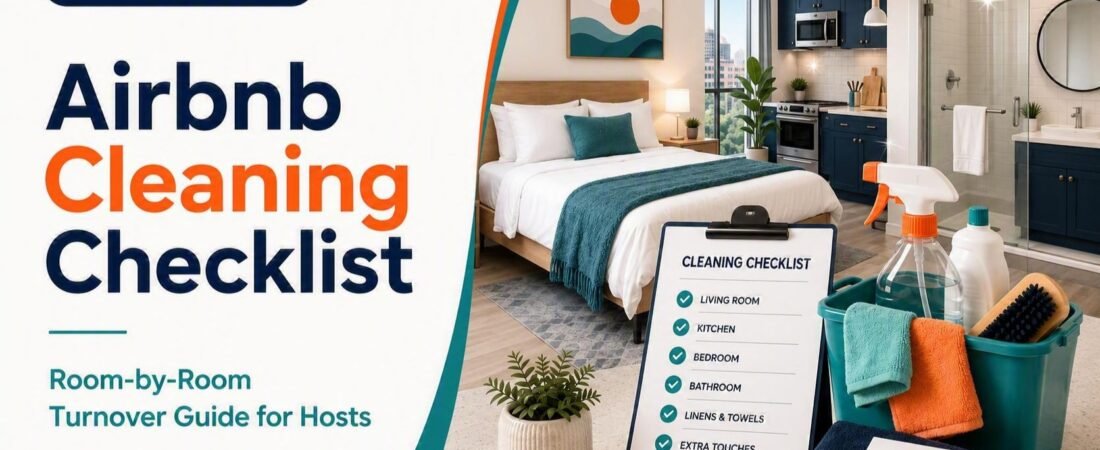
A spotless turnover is what turns a one-time booking into a five-star review. This is the room-by-room cleaning checklist we use to reset our rental between guests — built so you can run it yourself today and hand it to a cleaner later without quality slipping. It works the same on Airbnb, Vrbo, Booking.com, Agoda, and direct bookings.
A short-term rental cleaning checklist is a fixed, room-by-room sequence for turning your property over between guests, so every guest walks into the same spotless space your listing photos promised. The goal is not just "clean" — it is repeatable, inspection-level clean that protects your reviews even when you are tired, rushed, or handing the job to someone else. The fastest way to get there: clean in the same order every time, restock to set par levels, then do a separate fresh-eyes inspection pass before you call it done.
What is a short-term rental cleaning checklist?
A short-term rental cleaning checklist is a written, room-by-room list of every cleaning and restocking task you complete between guests. It exists for one reason: consistency. A guest does not care that you cleaned brilliantly for your last five bookings — they care about the one stay that is theirs. A checklist removes memory and mood from the equation so the standard is identical every single turnover.
If you are still setting up your property and have not taken your first booking yet, start with our step-by-step guide on how to become an Airbnb host first, then come back here to build the cleaning system that keeps your reviews high once guests start arriving.
Why a cleaning checklist matters more for rentals than for your own home
Cleaning your own home is forgiving. You know where the dust hides, nobody is reviewing you, and "good enough" is genuinely good enough. A rental turnover is the opposite on every count:
- It is judged in public. One missed clump of hair in the shower can become a permanent line in your reviews, and cleanliness is one of the first things guests rate.
- It is time-boxed. A checkout at 11 a.m. and a check-in at 3 p.m. gives you a hard window. There is no "I'll get to it later."
- It is often delegated. The moment a cleaner, co-host, or partner does the turnover instead of you, your standard only survives if it is written down.
- The bar is "hotel," not "tidy." Guests are paying nightly rates and comparing you to hotels and other listings, not to a friend's spare room.
A checklist is what lets a tired host at the end of a long week still deliver the same clean as their best day. That reliability is what compounds into Superhost status and Guest Favorite-level reviews over time.
How long should a turnover clean take?
For a one-bedroom condo or apartment, a thorough turnover usually takes about 1.5 to 2.5 hours solo, or closer to an hour with two people. Studios run faster; larger homes with multiple bathrooms and bedrooms can stretch to three or four hours. Your real number depends on your layout, how messy guests tend to leave it, and whether laundry happens on-site or off-site.
Time your own turnover honestly, once. Run a full clean with a stopwatch and write down the real total — including laundry, restocking, and the inspection pass. That single number tells you the minimum gap you need between a checkout and the next check-in. Booking back-to-back without enough buffer is one of the fastest ways to either burn out or send out a half-cleaned property.
The complete room-by-room cleaning checklist
Clean top to bottom and back to front in every room, so dust and debris fall onto surfaces you have not cleaned yet, and you finish at the door. Work the rooms in the same order every time — that order is what makes the routine fast and hard to forget.
Before you start: the turnover kit
Keep one caddy stocked and ready so you are never hunting for supplies mid-clean:
- All-purpose cleaner, glass cleaner, bathroom/disinfectant cleaner
- Microfiber cloths (color-code: one set for bathrooms, one for kitchen, one for glass)
- Toilet brush, scrub sponge, non-scratch sponge
- Vacuum, mop and bucket, broom and dustpan
- Trash bags, rubber gloves, lint roller
- Fresh linens and towels (see par levels below)
- Restock supplies: toilet paper, soap, coffee, dish soap, sponges
Kitchen
- Empty and wipe the fridge; remove anything guests left behind; wipe shelves and the handle
- Clean the microwave inside and out, including the turntable
- Wipe the stovetop, oven front, and range hood; degrease as needed
- Descale and rinse the kettle and coffee maker; remove old pods or grounds
- Run or empty the dishwasher; wash, dry, and put away every dish, glass, and utensil
- Wipe all counters, the backsplash, and cabinet fronts (especially around handles)
- Clean the sink and faucet; check the drain for food debris
- Restock: dish soap, sponge, paper towels, trash bags, coffee, tea, and any pantry basics you provide
- Empty the trash and reset a fresh liner; wipe the bin lid and rim
Bathroom
- Scrub the toilet inside and out, including the base and behind the bowl
- Clean the shower or tub, walls, and door; remove every strand of hair from walls and the drain
- Descale the showerhead and faucets; polish chrome so it shines
- Clean the sink, counter, and mirror (mirrors are a top spot for smudges guests notice immediately)
- Wipe down high-touch points: light switches, door handles, and the flush button or handle
- Replace all towels with fresh sets; fold or hang to match your listing photos
- Restock toilet paper (leave at least two spare rolls visible), hand soap, and any toiletries you provide
- Empty the bin, replace the liner, and put down a fresh bath mat
Bedroom
- Strip the bed completely and inspect the mattress and protector for stains
- Make the bed with fresh, wrinkle-free linens; a crisp, hotel-style bed is the single highest-impact thing a guest sees
- Check under the bed and behind nightstands for forgotten items and dust
- Dust all surfaces: nightstands, headboard, lamps, picture frames, and shelves
- Wipe high-touch items: light switches, remote controls, and drawer handles
- Clean mirrors and any glass; check inside the wardrobe and provide clean hangers
- Vacuum the floor, including edges and under furniture where possible
Living area and shared spaces
- Plump and straighten cushions; check between and under sofa cushions for crumbs and items
- Dust all surfaces, the TV screen, shelves, and decor
- Wipe remote controls, switches, and door handles
- Clean glass doors, windows within reach, and mirrors
- Wipe down the air-conditioner vents and clean or rinse the AC filter on a regular schedule
- Sweep, vacuum, and mop all hard floors; vacuum rugs and carpets
- Reset any welcome items, guidebooks, or remotes to their exact display position
Final guest-ready walkthrough
- Take out all trash and reset fresh liners in every bin
- Check that every light, lamp, and the AC/heating works
- Confirm Wi-Fi is on and the password card is in place
- Do a smell check — open a window, air the space, and make sure it smells clean and neutral, not musty or perfumed
- Set the thermostat or AC to a comfortable arrival temperature
- Lock up and reset any smart lock codes for the next guest
Want this as a print-and-go version?
The Rental Host Cleaning Checklist
The full checklist above is yours to use for free. If you would rather hand your cleaner a clean, branded, print-ready sheet — plus an editable version you can customize for your own property and a built-in par-level tracker — we packaged exactly that.
Get the Cleaning Checklist — $27Linen and consumable par levels: the part most new hosts skip
The "rule of three" keeps you turnover-proof: keep three full sets of every linen — one in use, one clean in the closet, and one in the wash. With three sets you can always turn the property over on time, even when the laundry from the last guest is not dry yet. This is the difference between a calm same-day turnover and a panicked one.
| Item | Par level (the rule) | Example: 1-bedroom, sleeps 2 |
|---|---|---|
| Fitted sheets | 3 per bed | 3 |
| Duvet covers / flat sheets | 3 per bed | 3 |
| Pillowcases | 3 × number of pillows | 6 (2 pillows) |
| Bath towels | 3 × guests the listing sleeps | 6 |
| Hand towels & washcloths | 3 sets | 3 each |
| Kitchen towels | 3 | 3 |
| Bath mats | 2–3 | 3 |
For consumables, decide your minimum stock and never let it drop below one spare turnover's worth. A simple starting par list:
- Bathroom: toilet paper (always leave 2+ spare rolls), hand soap, body wash, shampoo, conditioner
- Kitchen: dish soap, sponge, paper towels, trash bags, coffee, tea, salt and pepper, cooking oil
- General: spare light bulbs, batteries for remotes and the smart lock, and any welcome amenities you offer
Restock when you hit one spare, not when you hit zero. Running out of toilet paper mid-stay is one of the most common — and most avoidable — review complaints. Treat consumables like an inventory, not an afterthought.
Guest-facing clean vs inspection-level clean
A guest-facing clean makes the obvious surfaces look good. An inspection-level clean catches the hidden spots that quietly cost you reviews. The gap between the two is where most one-star cleanliness complaints live, because the room genuinely looks clean — it just is not.
The fix is a two-pass method: do your full cleaning pass, then walk the property again with fresh eyes as if you were the guest. The single best version of this: sit down on the bed and look around the room slowly. You will spot smudges, dust on the lamp, and a missed cobweb that you walked straight past with a cloth in your hand.
The spots that look clean but usually are not:
- Hair — the number-one cleanliness complaint. Check shower walls, drains, behind the toilet, and under the bed.
- Inside appliances — the microwave, oven, fridge, kettle, and coffee maker
- Air-conditioner filters and vents — in humid climates a clogged filter produces a musty smell that reads as "dirty" even when every surface is spotless
- High-touch items — remotes, light switches, door handles, and the inside of the trash can
- Glass and mirrors — smudges are instantly visible the moment a guest walks in
- Under and behind furniture — where the last guest's lost items and dust collect
End the inspection pass by taking a few photos of the finished, staged space. Match them to your listing photos so the property always resets to what guests were promised — and those photos double as your own dated record if a guest ever disputes the condition at check-in.
How to build a repeatable turnover system
A checklist is the foundation. A system is what keeps that checklist running reliably as your bookings grow and you stop doing every clean yourself. Three things turn a checklist into a system:
- One fixed order, every time. Same rooms, same sequence, same finish at the front door. Routine is what makes a turnover fast and hard to get wrong.
- Reference photos as the standard. Whether you clean or someone else does, the property resets to match a set of "this is done correctly" photos. This is how you delegate without quality dropping.
- A confirmation step. When a cleaner finishes, they send a quick photo or message confirming the turnover is complete. No guessing whether the property is guest-ready.
As you scale past a handful of bookings a month, scheduling becomes the real headache — matching every checkout to a cleaner, attaching the right checklist, and confirming completion. A turnover tool like Turno pulls your booking calendar automatically, assigns and notifies a cleaner the moment a guest checks out, and attaches your checklist with photo confirmation, so nothing falls through the cracks. It is genuinely useful once you are juggling more turnovers than you can track by hand; before that, a calendar reminder and a shared checklist do the job for free.
For the automation-minded host: if you run your own workflows, you can trigger a cleaning task automatically from your booking calendar — fire a notification to your cleaner the moment a stay ends, log the turnover, and prompt for a completion photo. It is the same logic the dedicated tools use, built into a system you already control.
Should you charge a cleaning fee?
Most hosts do charge a cleaning fee, but how you set it matters more than it used to, because the major platforms now show guests the total price upfront. A clean-looking listing with a hidden high cleaning fee no longer works the way it once did.
Here is what changed, and what it means for you:
- Airbnb rolled out total-price display globally in 2025, and it now shows the all-in price by default in search results. The cleaning fee is folded into the displayed nightly rate, though guests can still see it itemized at checkout. The practical effect: on short stays, a large cleaning fee inflates your total and can make your listing look expensive at a glance. For short-stay markets, build more of your cleaning cost into the nightly rate instead.
- Vrbo shows all mandatory fees, including the cleaning fee, upfront before a guest confirms. You enter it in the dedicated fee field in your dashboard, not just in the listing text.
- Booking.com and Agoda handle extra fees differently by market and listing type. Check your extranet to see exactly how a cleaning charge is displayed to guests before you set one.
Whatever you charge should at minimum cover your real costs: laundry, consumables, and your time (or your cleaner's invoice). The honest way to set it is to look at how comparable listings in your area and property size price their stays as an all-in total, then position yourself competitively rather than copying a number from a blog. Revisit it every few months — there is no fee that is "right" forever, and no fee guarantees more bookings or a better ranking. Treat it as a pricing lever you test, not a fixed truth.
Cleaning mistakes that quietly cost you reviews
- Cleaning from memory instead of a checklist. Without a written list, the quality of each turnover depends on how rushed or tired you are that day. Consistency is the whole game.
- Skipping the inspection pass. The cleaning pass makes it look clean; the inspection pass catches the hair, smudges, and dust that actually generate complaints.
- Under-budgeting turnover time. Booking a check-in too soon after a checkout leads to either a rushed, half-clean property or a frantic host. Know your real turnover time and protect that buffer.
- Forgetting to restock consumables. "There was no toilet paper" is an easy five-star to lose over a few cents of supplies.
- Not resetting to your listing photos. Guests expect the exact space they saw when they booked. Stage every turnover back to those photos.
- Keeping only one or two sets of linens. Without backup sets you cannot turn the property over on time when laundry is still running. Stock to par levels.
- Ignoring smell. A spotless-looking space that smells musty — often from an AC filter or a damp towel left behind — still reads as "dirty" to a guest. Always do a smell check before you lock up.
Just getting started?
Grab the free New Host Launch Checklist
Cleaning is one piece of running a rental well. Our free launch checklist walks you through everything else you need to set up before — and after — your first booking, step by step.
Get the free checklistIf you want the cleaning system plus the maintenance checklist and booking tracker that go alongside it, they live together in our Property Operations Pack — the full back-of-house toolkit for keeping a rental running smoothly.
Frequently asked questions
How often should I deep clean my short-term rental?
Do a full turnover clean between every single guest. On top of that, schedule a deeper clean — descaling, behind and under appliances, grout, baseboards, and the mattress — roughly once a month or every 10 to 15 turnovers, whichever comes first. Higher-traffic properties need it more often.
Should I clean my rental myself or hire a cleaner?
Clean it yourself in the early days if you can. It keeps costs down and, more importantly, lets you set the exact standard your future cleaner will follow. As your bookings grow and turnovers start eating your time, hire a cleaner and hand them your checklist plus reference photos. Either way, the same written checklist is what keeps quality consistent.
How much should I charge for a cleaning fee?
Enough to cover your laundry, consumables, and time or your cleaner's invoice. Because platforms like Airbnb and Vrbo now show guests the total price upfront, check how comparable listings in your area and property size price their all-in stays and position yourself competitively — especially for short stays, where a high cleaning fee makes your total look expensive. Review it every few months; no fee guarantees more bookings or a higher ranking.
How long does an Airbnb turnover take?
It depends on the property. A one-bedroom condo or apartment typically takes about 1.5 to 2.5 hours solo, studios are faster, and larger homes can take three to four hours. Time your own turnover once with a stopwatch — including laundry and restocking — and use that real number to set the minimum gap you need between a checkout and the next check-in.
What is the most common cleaning complaint from guests?
Hair and lingering smells. Both are "looks clean but isn't" problems: the surfaces appear spotless, but a strand of hair in the shower or a musty odor from the AC tells the guest otherwise. A separate inspection pass — and a smell check before you lock up — catches both.
Do I need a different cleaning checklist for Airbnb, Vrbo, and Booking.com?
No. The physical cleaning is identical no matter which platform the booking came from, so one checklist covers them all. What differs between platforms is how fees and policies work and how the cleaning fee is displayed to guests — not how you clean the property.