Airbnb vs Booking.com for New Hosts: Which Should You List On First?
If you only have time to set up one platform well, start with Airbnb — then add Booking.com once your listing is established and you want international reach. That’s the short answer. Below is the full breakdown, including real numbers from running a listing on both.
The quick answer
For most new hosts, Airbnb is the better first platform — it’s easier to set up, the guest experience is more host-friendly, and in many markets it simply brings in more bookings. Booking.com is worth adding second, especially if your property attracts international travellers, because it handles payments for you and opens up a large overseas audience. Listing on both eventually is the goal; the question is just which to master first.
Where this comparison comes from
This isn’t a roundup of other people’s blog posts. I run an actual short-term rental — a one-bedroom condo — listed on both Airbnb and Booking.com (plus a few others). On Airbnb I’m a Superhost; on Booking.com I’m a Preferred Plus partner and a Genius Level 3 host. So this comes from succeeding on both, not from preferring one and dismissing the other.
I started on Airbnb first and added Booking.com later — which, as it turns out, is exactly the order I’d recommend to most new hosts. Here’s why.
The biggest difference nobody warns you about: who actually books
Commission rates get all the attention, but the difference that shaped my hosting day-to-day was who each platform sends you.
On my listing, roughly 80% of bookings come from Airbnb and 20% from Booking.com. But the more interesting split is the type of guest:
- Airbnb guests skew local. Most of my Airbnb bookings are domestic travellers — people from the same country booking a staycation, a work trip, or a visit to family.
- Booking.com guests skew international. Booking.com has enormous brand recognition with overseas travellers, so a much larger share of those bookings are foreign visitors.
Why this matters for a new host: your ideal first platform depends on your market. If your property is in a city that runs on international tourism, Booking.com’s reach is valuable early. If your bookings are likely to come from domestic travellers — which is true for a lot of properties — Airbnb is where your demand actually lives, so that’s where to start.
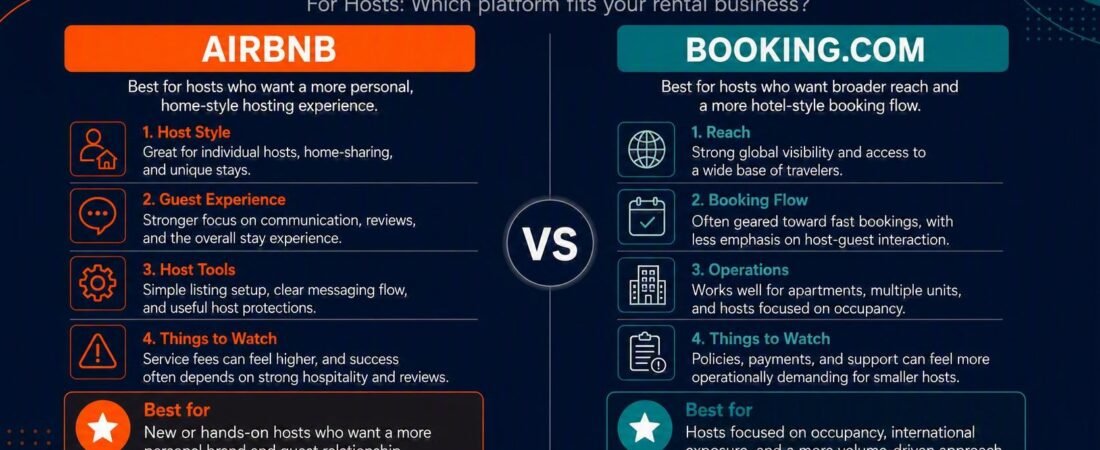
Airbnb vs Booking.com: side-by-side comparison
Here’s how the two platforms compare on the factors that matter most to a new host. Fees in particular change often and vary by country, so treat these as current-as-of-2026 guidance and always confirm your own rate in your account.
| Factor | Airbnb | Booking.com |
|---|---|---|
| Who pays the fee | Most hosts are now on a 15.5% host-only fee (guests pay no separate fee). Some independent hosts — like me — are still on the older split fee: ~3% from the host, 14–16.5% added to the guest. | Commission comes entirely from the host. No separate guest-side platform fee, but guests often pay more overall for the same room. |
| Typical fee / commission | 15.5% host-only in most markets (or ~3% host under the legacy split fee, where still available). | Roughly 10–25%, global average ~15%. Visibility programs add to it — as a Genius Level 3 host I pay an effective ~20%. |
| Who handles payment | Airbnb collects from the guest and pays you out. Hands-off. | Varies by setup. In mine, Booking.com collects and pays me out — so I’m not chasing cards myself. |
| Cancellations / no-shows | Cancellation policies are host-selected and generally stick. Lower no-show rate in my experience. | Free-cancellation bookings are common and heavily promoted, so cancellations and no-shows run noticeably higher — my single biggest frustration (more below). |
| Guest type | Skews local / domestic in my market. | Skews international — strong overseas brand recognition. |
| Ease of setup | Noticeably easier. Friendly onboarding, intuitive app, fast to publish. | More of a learning curve — the host extranet is powerful but less beginner-friendly. |
| Guest communication | Solid built-in messaging. | Comparable — honestly no real difference for me day-to-day. |
| Best for | New hosts; domestic-heavy markets; hosts who want the simplest start. | International-facing properties; hosts wanting hands-off payments and a second demand channel. |
Fees and policies change and differ by country. Confirm your own commission in your Airbnb (Account > Payments & Payouts > Service fee) or Booking.com extranet before making decisions.
Where Booking.com frustrated me most
If I had to name one thing, it’s cancellations and no-shows. Booking.com leans heavily on free-cancellation rates to win the guest’s click, which is great for travellers but means a confirmed booking is less “confirmed” than it feels. I’ve had noticeably more last-minute drop-offs on Booking.com than on Airbnb.
The practical fix: consider offering a non-refundable rate plan alongside your flexible one. It usually carries a lower commission and filters for guests who actually intend to show up. Just weigh it against the hit to conversion — some guests will only book flexible.
Where Booking.com genuinely earns its place
None of the above means skip Booking.com. It pulls real weight once you’re ready for it:
- International reach. That overseas audience is hard to reach any other way — it’s a different pool of guests, not the same ones from Airbnb.
- Hands-off payments. Booking.com handling the payout means one less thing to manage, which matters as you scale.
- Visibility programs. Genius and Preferred Plus do drive more views — you pay for it in commission, but the demand is real.
This is why “add it second” is the recommendation, not “avoid it.” It’s a strong second channel; it’s just a harder first one.
Ease of setup and day-to-day running
For a brand-new host, this is where Airbnb pulls ahead clearly. Airbnb’s onboarding holds your hand — the app is intuitive, publishing your first listing is quick, and the whole flow assumes you’ve never done this before. Booking.com’s extranet is more powerful in some ways but has a steeper learning curve; it feels built for someone who already knows the ropes.
That gap is a real part of the “Airbnb first” logic. When you’re learning everything at once — pricing, photos, house rules, guest messaging — the platform that fights you less is worth a lot.
So which should a new host pick?
Here’s the honest, situation-based call:
- Domestic / local-heavy market → start with Airbnb. Your demand lives there, it’s easier to learn, and you can add Booking.com once you’re comfortable.
- Tourist-heavy, internationally-driven market → consider both early. If foreign travellers are your bread and butter, Booking.com’s reach is worth the steeper setup — but still get Airbnb running first if you can only do one well.
- Either way, the end state is both. Listing across platforms is how you maximise occupancy. Just don’t spread yourself thin on day one — do one properly, then expand.
One caution if you list on both: you’ll need to prevent double bookings by syncing calendars (or using a channel manager). That’s a whole topic on its own — the free checklist below covers the setup basics.
Free: New Host Launch Checklist
164 checkpoints across 10 sections — listing setup, pricing, house rules, guest messaging, and avoiding double bookings across platforms. Works for Airbnb, Booking.com, and beyond.
Get the free checklistListing on both platforms means writing your house rules, guest messages, and check-in guide once and reusing them everywhere. If you’d rather not start from a blank page, the Guest Experience Pack gives you all three, ready to customise for any platform.
Frequently asked questions
Is Airbnb or Booking.com cheaper for hosts?
It depends on your fee model and market. Most Airbnb hosts now pay a 15.5% host-only fee, while some independent hosts remain on the older ~3% split fee (where guests pay the rest). Booking.com commission averages around 15% but ranges from 10–25%, and visibility programs push it higher — as a Genius Level 3 host I pay an effective ~20%. Always confirm your own rate in your account, since it varies by country and settings.
Can I list my property on both Airbnb and Booking.com at the same time?
Yes, and most established hosts do. The key is keeping your calendars in sync to prevent double bookings — either by manually blocking dates or by using a channel manager that updates availability across both platforms automatically.
Why does Booking.com have more cancellations?
Booking.com heavily promotes free-cancellation rate plans to win guests, so a larger share of bookings can be cancelled at little or no penalty. In my experience this leads to noticeably more last-minute cancellations and no-shows than Airbnb. Offering a non-refundable rate plan alongside your flexible one can reduce this.
Which platform is better for a brand-new host?
For most new hosts, Airbnb — it’s easier to set up, more beginner-friendly to run, and in many markets brings in more bookings. Add Booking.com second, once your listing is established and you want to reach international travellers.
What about Vrbo, Agoda, or Trip.com?
They’re worth considering once you’ve mastered your first one or two platforms, and the right fit depends on your market — Vrbo skews toward families and North America, while Agoda and Trip.com are strong across Asia. We’re covering each in its own dedicated comparison; in the meantime, see Airbnb vs Vrbo for new hosts and Airbnb vs Agoda for new hosts .
Platform fees, programs, and policies change frequently and vary by country and property type. Short-term rental laws and tax rules also differ by location — always confirm current platform terms and check your local regulations before listing. The figures above reflect my own experience and publicly available information as of 2026.