
Quick answer
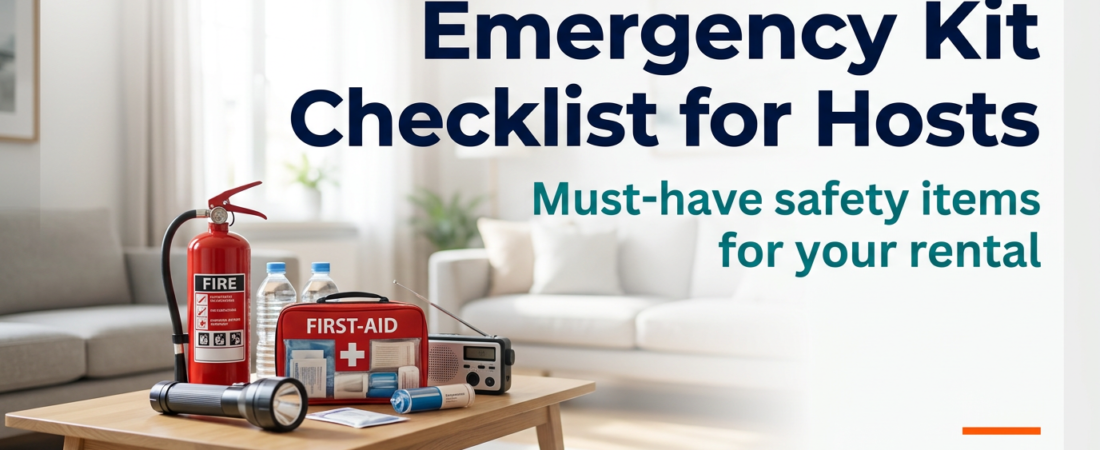
A short-term rental emergency kit checklist should include a suitable fire extinguisher, smoke alarms, carbon monoxide alarms where appropriate, a first-aid kit with basic wound-care supplies, a flashlight, an emergency contact card, and property-specific safety information. Add a dedicated Safety & Emergency section to your digital check-in guide so guests can find it quickly. Always follow the equipment manufacturer’s instructions, applicable local fire and safety codes, platform requirements, and building rules.
What is a short-term rental emergency kit?
A short-term rental emergency kit is a collection of safety equipment, basic supplies, and property information prepared for situations such as a fire, minor injury, power outage, water leak, or other urgent problem.
It includes physical equipment such as a fire extinguisher and first-aid supplies, along with clear instructions showing guests where to find emergency contacts, exits, approved shut-off controls, and your preferred contact method.
The goal is not to promise that nothing will go wrong. It is to make important safety information easier to find so guests can respond appropriately during an unexpected situation.
For immediate danger: Guests should leave the property, call the applicable local emergency number, and contact the host only after reaching a safe location. Messaging the host is not a substitute for contacting emergency services.
What must-have items should every emergency kit include?
Every short-term rental should have a core set of safety items appropriate for the property. Exact requirements vary by location, building type, appliance setup, and local regulations, so verify what applies to your rental before purchasing or installing equipment.
| Item | Why it matters | Beginner tip |
|---|---|---|
| Fire extinguisher | May help a trained adult control a very small, contained fire when there is a clear and safe exit | Choose the appropriate extinguisher type and rating for the location. Install it according to the manufacturer’s instructions and applicable fire codes. Guests should evacuate and call emergency services if there is smoke, rapid fire growth, or any uncertainty. |
| Smoke alarms | Alert guests to smoke or fire so they can evacuate early | Install, test, maintain, and replace alarms according to the manufacturer’s instructions and applicable local codes. Record testing and replacement dates in your turnover or maintenance log. |
| Carbon monoxide alarms | Detect carbon monoxide, an odorless gas that may be produced by fuel-burning appliances, fireplaces, or attached garages | Install alarms where required and follow the manufacturer’s placement instructions and local codes. Check each unit’s end-of-life or replacement date. |
| First-aid kit with basic wound-care supplies | Helps guests address minor cuts, scrapes, or small wounds while deciding whether professional care is needed | Include sealed bandages, antiseptic wipes, sterile gauze, medical tape, and disposable gloves. Avoid medication, pills, supplements, and other consumable health products. |
| Flashlight or emergency light | Provides light during a power outage or evacuation | Keep one in an easy-to-find common area. Test it regularly and store spare batteries safely away from children. |
| Emergency contact card | Gives guests local emergency numbers, property-specific instructions, and your contact method | Place a printed copy near the entrance and include the same information in your digital check-in guide. |
These items form the foundation of a practical short-term rental emergency kit checklist. Your exact setup should reflect your property, local rules, building requirements, and the instructions provided with each piece of equipment.
Host tip: Add emergency-equipment checks to your regular maintenance checklist and issue log. Recording inspection dates is more reliable than depending on memory.
Organize the rest of your hosting setup
Emergency preparation is only one part of launching a rental. Use the free Host Launch Checklist to review your listing, safety items, guest communication, and operating setup.
What optional emergency supplies can you add?
Once the essential safety equipment is in place, you can add supplies that make guests more comfortable during temporary disruptions. These are optional and should not replace required safety equipment or professional emergency assistance.
- Battery-powered lantern: Provides broader light than a small flashlight during a power outage.
- Extra blankets: Helpful during a temporary heating interruption or severe weather.
- Sealed drinking water: Useful in locations affected by storms, service interruptions, or boil-water advisories. Check storage conditions and expiration dates.
- Portable charging bank: Helps guests keep a phone charged during a short power interruption. Inspect it regularly and follow the manufacturer’s storage instructions.
- List of nearby emergency rooms, urgent care centers, and 24-hour pharmacies: Helps guests find appropriate services without searching during a stressful situation.
Host tip: Store spare batteries in their original packaging or a proper battery organizer, away from children, heat, moisture, and metal objects. Loose coin or button batteries can be particularly dangerous if swallowed.
How to organize emergency information for guests
Having the right equipment is only half the work. Guests also need to know where important items are located and what actions they should take.
Place a dedicated Safety & Emergency section near the beginning of your digital check-in guide, ideally after the door-access instructions. Use a clear heading and keep the information easy to scan on a phone.
What to include in your emergency information section
- Applicable local emergency number: Include the correct police, fire, ambulance, and poison-control information for the property’s location.
- Nearest emergency medical facility: Include the name, address, phone number, and a map link when possible.
- Building security or front-desk contact: Include daytime and after-hours details for condos or apartment buildings.
- Emergency exits and evacuation route: Explain the safest exit and the designated meeting point when required.
- Main water shut-off information: Provide instructions only when the control is clearly labeled, accessible, and safe for a guest to operate.
- Circuit-breaker location: Identify the panel, but do not instruct guests to investigate electrical equipment when there is smoke, a burning smell, exposed wiring, sparking, or water near electrical sources.
- Property-specific instructions: Include relevant information for elevators, stairwells, parking gates, generators, pools, gas appliances, or other property features.
- Host contact method: Ask guests to message you through the booking platform for non-life-threatening property issues.
- Local backup contact: Provide a co-host, property manager, or authorized local contact when appropriate.
In my hosting setup, I include a dedicated Safety & Emergency section in the digital guide immediately after the door-lock instructions. It is clearly labeled and positioned near the top so guests do not need to scroll through unrelated information during an urgent situation.
Host tip: For non-emergency maintenance problems, use a clear message such as: “If any appliance malfunctions, or if you notice a leak or maintenance issue, please notify us through the booking app as soon as possible so we can assess it.” Add separate instructions telling guests to evacuate and contact emergency services when there is immediate danger.
Remote-host backup steps
If you manage your rental from a distance, prepare a local response plan. Identify a trusted co-host, property manager, maintenance provider, or authorized neighbor who can assist when you cannot reach the property quickly.
Your backup contact should know:
- How to access the property legally and securely
- Where emergency equipment and shut-off controls are located
- Which situations require emergency services
- Which situations can be handled by building management or maintenance
- How to document and report what happened
Do not publish private access codes or unrestricted backup-contact details where they could be viewed by people who are not confirmed guests. Share sensitive information only through an appropriate secure channel.
Building and security contact workflow
Guests staying in a condo or apartment building may need help with common-area issues such as a locked entrance, elevator interruption, parking-gate problem, alarm activation, or evacuation notice.
Include the building security number, front-desk number, and after-hours process in your guest guide. Explain when guests should contact building staff directly and when they should message you. Confirm that your instructions do not conflict with the building’s official emergency procedures.
What not to promise guests
Avoid promising uninterrupted Wi-Fi, electricity, water, air-conditioning, elevators, or other services that can be affected by providers, building management, severe weather, maintenance, or external events.
Do not promise that an emergency kit will prevent every accident or that you can arrive immediately at any hour. Instead, provide accurate expectations, clear emergency instructions, and a reliable process for reporting non-emergency problems.
How to keep emergency instructions updated across platforms
Create one master source containing your approved emergency contacts, property instructions, equipment details, and backup procedures. Whenever something changes, update that source first and then synchronize the relevant information across your check-in guide, house rules, listing details, and direct-booking materials.
Depending on your integration, some property or safety details may sync through a channel manager or property management system. Do not assume synchronization is complete. Verify the information directly on every active platform after making changes.
Set a recurring review at least every three months and whenever any of the following changes:
- Host, co-host, or building contact information
- Emergency equipment or its location
- Building procedures or evacuation routes
- Local emergency numbers or medical facilities
- Platform settings or listing information
- Property access, locks, utilities, or major appliances
You can also include these instructions in your house rules and your guest communication workflow, while keeping the most urgent information easy to access inside the check-in guide.
What to avoid in your emergency kit
Knowing what not to provide is just as important as choosing useful equipment. Some items expire quietly, require specialized knowledge, or can create confusion during a stressful situation.
Items and practices to avoid
- Medication, pain relievers, allergy medicine, sleep aids, vitamins, supplements, or other consumable health products: These may cause allergic reactions, interact with other medication, expire, or be misused. Keep the guest first-aid kit limited to basic wound-care supplies.
- Expired, damaged, recalled, or uninspected safety equipment: Follow the manufacturer’s inspection, maintenance, service, and replacement instructions. Remove equipment that has reached its replacement date or shows signs of damage.
- Equipment guests are not expected to operate: Do not leave complex tools, electrical testing equipment, hazardous chemicals, or specialized safety equipment without appropriate controls and instructions.
- Overly complicated emergency instructions: Guests should not have to read a long manual during an urgent situation. Use short steps, clear headings, and prominent emergency-contact details.
- Unsafe utility instructions: Do not encourage guests to investigate electrical faults, gas leaks, active fires, or dangerous flooding. Tell them to leave the area and contact emergency services when there is immediate danger.
- Promises of uninterrupted utilities or instant response: Set realistic expectations and explain how guests should report problems.
Important: Emergency-equipment requirements vary by country, city, building, platform, and property type. Check applicable fire and safety codes, building administration or condo-association rules, equipment manufacturer instructions, insurance requirements, and short-term rental regulations. This guide provides general operational information and is not a substitute for professional fire-safety, medical, legal, or regulatory advice.
Platform and building considerations
Booking platforms and property types may collect safety information differently. Dashboard labels and settings can change, so treat the examples below as starting points and verify the current settings inside each platform.
| Platform or context | What to review |
|---|---|
| Airbnb | Review the listing’s safety-device and property-safety information. Confirm that every item shown in the listing is actually installed, maintained, and available at the property. |
| Booking.com | Review the property-facilities and safety-information sections. Verify the current requirements for your accommodation type and location. |
| Vrbo | Review the listing’s safety and security information and confirm compliance with applicable local fire and lodging requirements. |
| Agoda, Expedia, and Trip.com | Review safety and property information directly on each platform. Some details may sync from a connected channel manager or property management system, but synchronization can vary by platform and integration. |
| Direct-booking websites | Add clear safety information to the guest guide or confirmed-booking materials. Avoid publicly displaying sensitive access instructions or personal contact details. |
| Condo or apartment buildings | Verify building emergency procedures, evacuation routes, guest-registration requirements, security contacts, access restrictions, and whether short-term rentals are permitted under the building’s current rules. |
A condo or apartment building may already have common-area fire alarms, sprinklers, extinguishers, emergency lighting, and marked exits. That does not automatically mean the individual rental unit satisfies every applicable requirement. Confirm what the building provides and what the host must provide inside the unit.
A detached house or guesthouse may require a more extensive setup because the host may be responsible for more of the property’s safety equipment. Equipment placement and quantity should follow local requirements and manufacturer instructions rather than a universal “one per floor” rule.
Frequently asked questions
Do I need a carbon monoxide detector in my short-term rental?
A carbon monoxide alarm may be required when a property has fuel-burning appliances, a fireplace, an attached garage, or another potential source of carbon monoxide. Requirements and placement rules vary, so follow applicable local codes and the alarm manufacturer’s instructions. Even when not explicitly required, consider obtaining guidance from a qualified local safety professional.
What should a rental first-aid kit include?
A guest first-aid kit can include sealed basic wound-care supplies such as adhesive bandages, sterile gauze, antiseptic wipes, medical tape, and disposable gloves. Avoid medication, pills, supplements, vitamins, prescription products, and other consumable health products. Check the kit regularly and replace opened, damaged, contaminated, or expired items.
How often should I check emergency equipment in my rental?
Follow the inspection, testing, maintenance, and replacement schedule provided by each equipment manufacturer and required by applicable local rules. Add a visual safety check to your turnover process, record formal inspection dates, and replace damaged, expired, recalled, discharged, or end-of-life equipment promptly.
What should I tell guests about reporting maintenance issues?
Tell guests to contact emergency services first when there is immediate danger. For non-emergency issues, ask them to report appliance problems, leaks, damage, unusual smells, or maintenance concerns through the booking platform as soon as possible. Provide simple instructions and avoid asking guests to investigate electrical, gas, fire, or structural hazards themselves.
Do I need a different emergency kit for a condo and a house?
Possibly. A condo building may provide common-area alarms, sprinklers, emergency lighting, security contacts, and evacuation procedures, while a house may place more responsibility on the host. Confirm what the building already provides, what is required inside the unit, and what equipment is appropriate for the specific property.
Get the complete Host Launch Checklist
Setting up emergency equipment is one part of a larger launch process. The free Host Launch Checklist helps you review safety preparation, listing setup, guest communication, turnover procedures, and other important tasks before welcoming guests.
Download the Free Host Launch Checklist
For a more complete operating system, you can also explore the Property Operations Pack, which includes tools for cleaning, maintenance tracking, and booking operations.