
Platform Comparison
Airbnb vs Vrbo for New Hosts: Which Should You List On?
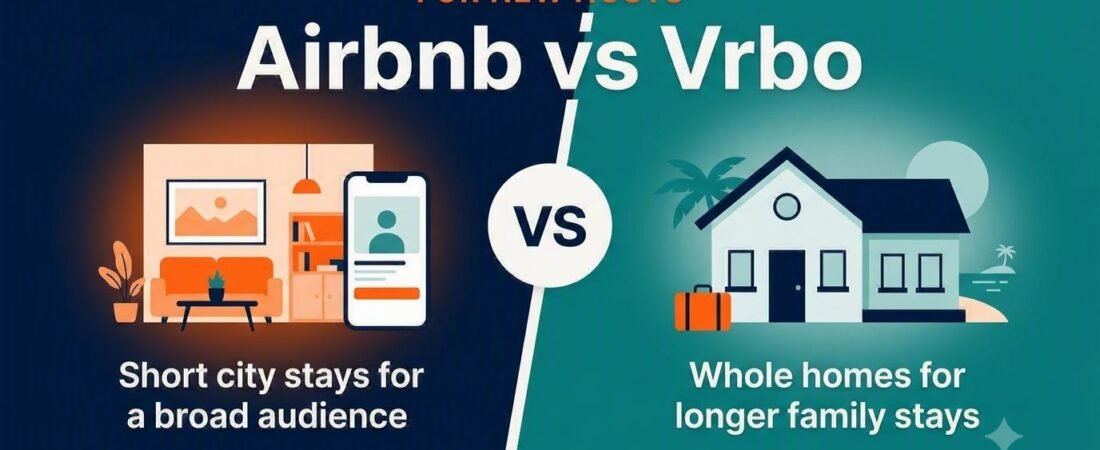
One accepts spare rooms and casts the widest net. The other is whole-homes only and built for families on longer stays. Here’s how they really differ — and what I see on my own listing across both.
For most new hosts, start with Airbnb, then add Vrbo only if you rent an entire place in a holiday or family-friendly market. Airbnb has the bigger, broader audience and accepts entire homes, private rooms, and shared rooms; Vrbo lists whole homes only and skews toward families and longer stays. Vrbo charges hosts about 8% per booking (a 5% commission plus 3% payment processing), with no upfront fee for new hosts, and adds a separate service fee that the guest pays at checkout. On my own one-bedroom — live on Airbnb, Booking.com, Vrbo, Agoda, and Trip.com — Vrbo brings fewer bookings than Airbnb but noticeably longer ones: more weekly and monthly stays. That’s exactly why I keep it active as a second channel rather than a first.
The one rule that settles it for many hosts
Before you compare anything else, check this: Vrbo only accepts whole-home rentals. Every guest must have exclusive access to the entire property — their own kitchen, bathroom, and entrance, with no shared or hosted spaces. If you rent a spare room while you live in the home, Vrbo simply isn’t an option for that setup, and Airbnb is. Airbnb accepts entire places, private rooms, and shared rooms; Vrbo is entire-place or nothing.
So the first question isn’t “which platform is better?” It’s “what am I actually renting?” My own listing is an entire one-bedroom, so it qualifies on both. If yours is a private room, the decision is already made for you — start with Airbnb and skip the rest of the Vrbo question for now.
Airbnb vs Vrbo at a glance
| What to compare | Airbnb | Vrbo |
|---|---|---|
| Property types | Entire places, private rooms, shared rooms | Whole homes only |
| Typical guest | Solo travellers, couples, business, broad mix | Families and groups, leisure travellers |
| Typical stay length | Shorter — weekend and city breaks | Longer — averaged ~5+ nights in 2025 |
| Host fees | ~3% host fee plus a guest service fee (split model), or roughly 14–16% host-only in many markets | ~8% per booking (5% commission + 3% processing); no upfront fee for new hosts |
| Guest-facing fee | Often absorbed into the host-only model | Separate service fee (~6–15%) shown at checkout |
| Reach beyond the app | Airbnb only | Expedia Group network (Expedia, Hotels.com and partners) |
| Top-host badge | Superhost (account-level) | Premier Host (per-listing as of 2026) |
| Best fit for new hosts | Almost everyone, first | Entire-place hosts in family / leisure markets, as a second channel |
Fee structures and badge criteria change and vary by market — always confirm the current numbers in each platform’s own help centre before you price your listing.
Audience and stay length: the real difference
Fees get the attention, but the bigger difference between these two platforms is who books on each — and for how long. That shapes your whole operation: cleaning frequency, pricing, even the photos you lead with.
Airbnb
The bigger, broader marketplace. Solo travellers, couples, business trips, and short city breaks — plus every property type, from a spare room to a full villa. More volume, shorter stays, more turnovers.
Best when you want reach and flexibility.
Vrbo
A narrower, leisure-focused audience: families and groups booking an entire home, often for a week or more. Fewer enquiries, but longer, higher-value stays and fewer turnovers per month.
Best when you have a whole place in a holiday market.
Vrbo is strongest in beach, mountain, rural, and family-holiday markets in North America and Europe. In dense, urban, or short-stay-heavy markets — or anywhere Vrbo simply has thin traveller demand — it can be quiet. That doesn’t make it useless; it makes it a channel you add for the type of guest it brings, not for raw volume.
What each platform charges hosts
On Vrbo, new hosts use the pay-per-booking model: roughly 8% per booking — a 5% commission on the rental amount plus any mandatory fees you charge, and a 3% payment processing fee. There’s no upfront cost, so you only pay when you earn. (The older annual subscription is now closed to new hosts and only renewable by existing subscribers, so most new listings will be on pay-per-booking.) Separately, the guest pays a service fee at checkout, which Vrbo keeps — so travellers see a higher total than your nightly rate alone.
On Airbnb, the fee depends on the model in your market: a split model where the host pays around 3% and the guest pays a service fee, or a host-only model where the host absorbs roughly 14–16% and the guest sees a cleaner price. The practical takeaway: Vrbo tends to leave more in your pocket per booking, but its visible guest fee can make your total look higher to a price-sensitive traveller.
Before you price: these percentages move and differ by region. Confirm the current host fee, guest service fee, and payout timing in each platform’s own help centre, and bake the real numbers into your nightly rate rather than relying on a general figure.
From my own listing: what Vrbo actually does for me
My one-bedroom runs on five platforms at once, so I get to watch them behave differently in real time. Here’s what Vrbo consistently does for me, honestly:
Fewer bookings, but longer ones. Vrbo is never my busiest channel by volume — but the stays it brings skew weekly and monthly far more than Airbnb does. Fewer turnovers, more nights per guest. For a one-bedroom, that’s a genuinely useful mix to have running in the background.
The video upload is the standout feature. Vrbo lets you add a video to the listing, not just photos. I used that to walk guests through the actual unit, and I’m fairly sure it’s part of why the longer-stay guests choose it — someone booking a week or a month wants to see the space move, not just scroll stills.
Setup was painless. I connected Vrbo directly, and the onboarding — account, verification, payout — ran without any friction worth complaining about. And because new hosts are on pay-per-booking, there was no upfront fee to commit before I knew whether the channel would pull its weight.
None of that is a promise about your numbers — my market, my property, and my pricing are mine, and yours will behave differently. But if you have an entire place and you’re weighing whether Vrbo is worth the setup time, “fewer but longer” is the pattern I’d tell a friend to expect, and the video is the lever I’d use first.
So which should a new host list on first?
List on Airbnb first. It has the largest, most diverse audience, it accepts every property type including spare rooms, and it’s the fastest way for a brand-new host to get real bookings and real reviews. Get your listing, photos, messaging, and check-in dialled in there first.
Add Vrbo as your second channel if — and only if — you rent an entire place and you’re in a market where families and groups book whole homes. If you rent a private room, Vrbo isn’t available to you; stay focused on Airbnb (and consider Booking.com next).
If you haven’t decided between Airbnb and Booking.com yet either, that’s the companion question to this one — I walk through it in Airbnb vs Booking.com for new hosts. Between the two comparisons you’ll have a clear order to launch in.
Should you list on both Airbnb and Vrbo?
For a lot of entire-place hosts, yes — once your first platform is running smoothly. Listing on both diversifies your bookings so you’re not dependent on a single channel, and Vrbo’s longer-stay guests can fill the gaps Airbnb leaves. The catch is the one risk that scares every new host: double bookings.
The moment your calendar lives in two places, you need it to sync automatically. Calendar (iCal) links sync on a delay, which leaves a window where two guests can book the same dates. A channel manager with a direct connection to both platforms blocks dates across every channel within seconds — that’s the reliable way to run two calendars without an awkward cancellation. I compare two popular options for new hosts in Hospitable vs Smoobu, and there’s a full setup walkthrough in my how to become an Airbnb host guide.
Frequently asked questions
Is Airbnb or Vrbo better for new hosts?
For most new hosts, Airbnb is the better starting point. It has a larger, broader audience and accepts every property type, including private and shared rooms, so it’s the fastest way to get your first bookings and reviews. Vrbo is best added as a second channel by hosts who rent an entire place in a family or holiday market, since it lists whole homes only and attracts longer, leisure-focused stays.
Can I list a private room on Vrbo?
No. Vrbo accepts whole-home rentals only — guests must have exclusive access to the entire property, including the kitchen, bathroom, and entrance. If you rent a spare room while living in the home, that model isn’t allowed on Vrbo, but it is supported on Airbnb. Only list on Vrbo if you’re renting the full place.
How much does Vrbo charge hosts?
New hosts use the pay-per-booking model: about 8% per booking, made up of a 5% commission on the rental amount plus a 3% payment processing fee, with no upfront cost. The guest also pays a separate service fee at checkout, which Vrbo keeps. An older annual subscription exists but is now closed to new hosts. Fees change and vary by region, so confirm the current numbers in Vrbo’s help centre before you price your listing.
Does Vrbo get fewer bookings than Airbnb?
It depends heavily on your property type and market. Vrbo’s audience is narrower and leisure-focused, so in many markets it produces fewer bookings than Airbnb — but those stays tend to be longer and higher in value. On my own one-bedroom across five platforms, Vrbo is never the busiest by volume, yet it brings more weekly and monthly stays than Airbnb does. Treat it as a channel you add for the type of guest it brings, not for raw volume.
Should I list on both Airbnb and Vrbo?
If you rent an entire place, listing on both is often worth it once your first platform is running smoothly — it diversifies your bookings and Vrbo’s longer stays can fill gaps. The key requirement is syncing your calendars so you never get a double booking. A channel manager with direct connections to both platforms updates availability within seconds, which is far safer than relying on delayed calendar links.
What is Vrbo’s version of Superhost?
It’s called Premier Host. Like Airbnb’s Superhost, it’s a free badge for hosts who consistently meet quality standards for ratings, booking acceptance, and low cancellations. As of 2026, Vrbo evaluates Premier Host per listing rather than per account, so each property qualifies on its own merit. The exact thresholds change over time, so check Vrbo’s current Premier Host criteria for the latest requirements.
Your next step
Decide what you’re actually renting — entire place or a room — then pick your launch order: Airbnb first for everyone, Vrbo as a second channel for whole-home hosts in the right market. From there, keep building your setup:
- Airbnb vs Booking.com for new hosts — the companion comparison for your second or third channel.
- How to Become an Airbnb Host — the full beginner roadmap, start to first booking.
- Airbnb Listing Setup Checklist — get your first listing built right before you expand.
- Hospitable vs Smoobu — pick a channel manager so two calendars never collide.
- Start Here — grab the free New Host Launch Checklist and the rest of the toolkit.
This article reflects my own multi-platform hosting experience and is general guidance, not legal, financial, or tax advice. Platform fees, rules, and host programmes vary by market and change over time — always verify current terms in each platform’s own help centre and check your local short-term rental regulations. Some links may be affiliate links; they cost you nothing extra and I only recommend tools I would use myself.