
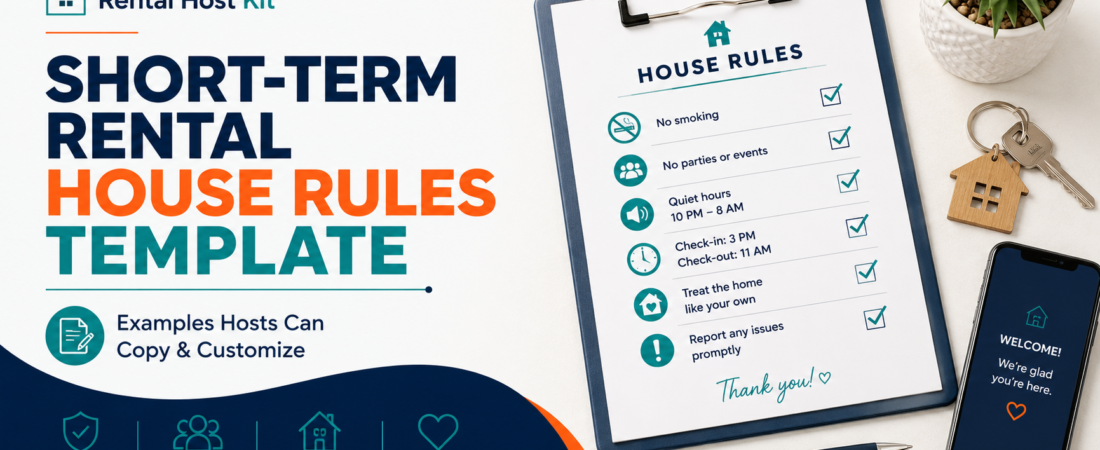
Short-Term Rental House Rules Template: Examples Hosts Can Copy and Customize
A practical, platform-neutral guide to writing clear house rules for Airbnb, Booking.com, Vrbo, Agoda, Expedia, Trip.com, and direct bookings.
- No parties or events✓
- Quiet hours✓
- Visitor policy✓
- Parking rules✓
- Checkout reminders✓
House rules are one of the easiest things for new short-term rental hosts to ignore until there is already a problem.
A guest brings extra visitors. Someone smokes inside. The parking rules are misunderstood. A neighbor complains about noise. A guest checks out late and delays your cleaner. Suddenly, you are trying to enforce a rule that was never clearly explained.
That is the real purpose of house rules.
They are not there to make your listing feel strict or unfriendly. Good house rules protect your property, set guest expectations, reduce misunderstandings, and give you something clear to point to if a problem happens.
In this guide, you will get a practical short-term rental house rules template you can customize for Airbnb, Booking.com, Vrbo, Agoda, Expedia, Trip.com, direct bookings, and other vacation rental platforms.
Use the examples below as a starting point, then adapt them to your property, local rules, building requirements, and booking platform policies.
If you are still setting up your listing or deciding which platform to start on, the Start Here guide walks you through the full short-term rental setup from scratch.
Important note: This article is for general hosting and operational guidance only. It is not legal advice. Short-term rental laws, platform rules, building rules, service animal policies, deposits, penalties, guest rights, and enforcement processes vary by location and platform.
Why House Rules Matter for Short-Term Rentals
House rules matter because guests cannot follow expectations they never saw clearly.
Many beginner hosts make the mistake of assuming guests will use “common sense.” That sounds reasonable, but common sense is not the same for every guest, country, travel style, age group, platform, or property type.
A guest staying in a condo may not understand strict building visitor rules. A group booking a vacation home may not realize “small gathering” feels like a party to the neighbors. A guest arriving by car may assume parking is included unless told otherwise.
Clear house rules help prevent:
- Unauthorized extra guests
- Parties and disruptive gatherings
- Smoking or vaping inside the property
- Noise complaints from neighbors or building security
- Parking confusion
- Late checkout delays
- Misuse of pools, gyms, elevators, or shared amenities
- Pet-related issues
- Trash, food, and pest problems
- Damage disputes
- Confusion over access codes, keys, or building passes
Good rules also protect the guest experience. When guests know what to expect before they arrive, they are less likely to feel surprised, restricted, or unfairly blamed later.
The goal is not to sound harsh. The goal is to be clear early.
What to Include in Short-Term Rental House Rules
A strong short-term rental house rules template should cover the rules that affect the guest before, during, and after the stay.
At minimum, your house rules should include:
- Maximum guest count
- Visitor policy
- Check-in and checkout times
- Early check-in and late checkout policy
- Quiet hours
- No parties or events rule
- Smoking and vaping policy
- Pet policy
- Parking rules
- Building, HOA, condo, or community rules
- Pool, gym, or shared amenity rules
- Kitchen and appliance use
- Trash disposal instructions
- Cleanliness expectations
- Damage and missing item process
- Keys, access cards, smart locks, and lockboxes
- WiFi and internet use
- Safety devices and emergency information
- Checkout instructions
- What happens if rules are violated
You do not need a long legal-style document for every property. A small studio apartment may only need simple rules. A condo, resort unit, villa, guesthouse, or direct booking property may need more detail.
The important thing is that your rules match your actual property. Do not copy rules from another host blindly. Their rules may not match your building, platform, local law, insurance, or guest type.
Free Short-Term Rental House Rules Template
Here is a simple short-term rental house rules template you can copy, edit, and paste into your listing, guest guide, or welcome book.
Short House Rules Template
Welcome to [PROPERTY NAME]. To help keep the home safe, clean, and comfortable for every guest, please review and follow these house rules during your stay.
Maximum guests: The property allows up to [MAX GUESTS] registered guests. Overnight guests must be included in the reservation.
Check-in and checkout: Check-in starts at [CHECK-IN TIME]. Checkout is by [CHECKOUT TIME]. Early check-in or late checkout must be approved in advance.
No parties or events: Parties, events, large gatherings, and disruptive behavior are not allowed.
Quiet hours: Please keep noise low between [QUIET HOURS].
Smoking policy: [SMOKING POLICY].
Pet policy: [PET POLICY].
Visitors: Visitors must be approved in advance and must follow all house, building, and community rules.
Parking: [PARKING RULES].
Shared amenities: Guests must follow all posted pool, gym, parking, elevator, building, and shared amenity rules.
Cleanliness: Please treat the home with care and leave it in reasonable condition at checkout.
Damages: Please report accidental damage or maintenance issues as soon as possible so they can be handled properly.
Security and access: Do not share keys, access cards, lockbox details, smart lock codes, or building passes with anyone outside your registered group.
Prohibited activities: Illegal activity, tampering with safety devices, unauthorized parties, and use of the property for unauthorized commercial activity are not allowed.
Checkout: Please follow the checkout instructions provided before departure.
Rule violations: Serious or repeated rule violations may be documented and handled through the proper booking platform, building management, or local process when necessary.
Thank you for helping us keep [PROPERTY NAME] safe, clean, and welcoming for every guest.
House Rules Examples by Category
The best house rules are specific enough to be useful, but not so aggressive that guests feel unwelcome.
Below are house rules examples for short-term rental hosts. Use the examples that match your property, then customize the details.
1. Maximum Guest Rule
A maximum guest rule helps prevent overcrowding, insurance issues, building complaints, and unauthorized overnight stays.
Example wording:
The property allows a maximum of [MAX GUESTS] registered overnight guests. All overnight guests must be included in the reservation. Additional overnight guests are not allowed unless approved in writing before arrival.
Softer version:
Please make sure the reservation reflects the correct number of overnight guests. The property can accommodate up to [MAX GUESTS] registered guests.
Host tip: Your maximum guest count should match your listing on every platform. Do not list one number on Airbnb, another on Booking.com, and another in your guest guide.
2. Visitor Policy
Visitor rules are especially important for condos, apartments, serviced residences, and buildings with security.
Example wording:
Visitors must be approved in advance. Approved visitors must follow all house rules, building rules, parking rules, quiet hours, and amenity restrictions. Visitors may not stay overnight unless added to the reservation and approved.
Strict building version:
Only registered guests may enter the property or building unless visitors are approved in advance. Building security may deny entry to unregistered visitors according to building policy.
Host tip: If your building has strict visitor registration, make this visible before booking. Hidden visitor restrictions can create guest frustration.
3. Check-In and Checkout Rules
Clear check-in and checkout rules protect your cleaning schedule.
Example wording:
Check-in starts at [CHECK-IN TIME]. Checkout is by [CHECKOUT TIME]. Early check-in or late checkout must be approved in advance and is not guaranteed.
Friendlier version:
Check-in starts at [CHECK-IN TIME], and checkout is by [CHECKOUT TIME]. If you need early check-in or late checkout, please message us in advance so we can check what is possible.
Host tip: Do not imply early check-in is guaranteed if it depends on your cleaner, the previous guest, or building access.
4. No Parties or Events Rule
A no parties rule should be direct, visible, and easy to understand.
Example wording:
Parties, events, large gatherings, and disruptive behavior are not allowed. Please keep the property peaceful and respectful for neighbors, building staff, and future guests.
Firmer version:
Parties, events, large gatherings, and disruptive behavior are strictly not allowed. Serious rule violations may be documented and reported through the proper booking platform or building process when necessary.
Host tip: Avoid dramatic wording like “instant eviction” unless your local law and platform process clearly support it.
5. Quiet Hours Rule
Noise rules work best when they include exact hours.
Weak wording:
No loud noise.
Better wording:
Please keep noise low between [QUIET HOURS], especially in hallways, balconies, shared areas, and outdoor spaces. Noise complaints from neighbors, building staff, or security may be documented.
Example:
Quiet hours are from 10:00 PM to 8:00 AM. Please keep music, voices, television, and hallway noise low during this time.
Host tip: If your building or city has official quiet hours, use those exact hours.
6. Smoking and Vaping Policy
Smoking rules should mention where smoking is not allowed and what counts as a violation.
No-smoking property example:
Smoking and vaping are not allowed anywhere on the property, including inside the home, on balconies, near windows or doors, and in restricted building areas.
Designated smoking area example:
Smoking and vaping are not allowed inside the property. Guests who need to smoke must use the designated outdoor smoking area: [DESIGNATED SMOKING AREA].
Firmer version:
Smoke odor, ash, burns, cigarette waste, or smoking-related damage may be documented and handled through the proper booking platform or direct booking process where allowed.
Host tip: Be careful with “smoking fines.” Some platforms may not support automatic penalties just because you wrote them in your rules. Use wording like “documented and handled through the proper process where allowed.”
7. Pet Policy
Pet rules need careful wording because platform rules and local laws may treat service animals and assistance animals differently from pets.
No-pets example:
Pets are not allowed at this property, except where required by applicable platform policy or local law.
Pet-friendly example:
Pets are allowed only with prior approval and must be included under the property pet policy. Guests are responsible for cleaning up after pets, preventing damage, controlling noise, and following building or local pet rules.
Detailed pet-friendly example:
One approved pet under [WEIGHT LIMIT] is allowed with prior approval. Pets must be kept off beds and furniture, must not be left unattended unless approved, and must follow all building and local rules.
Host tip: Do not use your pet policy to override service animal, assistance animal, accessibility, or anti-discrimination rules. These vary by platform and location.
8. Parking Rules
Parking confusion is one of the most common short-term rental problems, especially for condos and city properties.
Assigned parking example:
One assigned parking space is available at [PARKING SLOT / LOCATION]. Guests must register the vehicle plate number with [HOST / FRONT DESK / BUILDING SECURITY] before arrival. Please park only in the approved space.
No dedicated parking example:
No dedicated parking is included. Nearby paid or street parking may be available at the guest’s own expense, but availability is not guaranteed.
Paid parking example:
Parking is available at [LOCATION] for [FEE], subject to availability and building rules. Guests are responsible for following posted parking rules.
Host tip: Never promise parking you do not control. If parking is public, shared, paid, or subject to availability, say that clearly.
9. Building, Condo, or HOA Rules
For condos, apartments, gated communities, and serviced residences, building rules are just as important as your house rules.
Example wording:
Guests must follow all building, condo, HOA, security, elevator, trash, parking, amenity, and shared area rules during the stay. Building management or security may restrict access to amenities or common areas if rules are not followed.
Host tip: If the building has strict rules on visitors, ID registration, pool access, parking, smoking, or quiet hours, include those before booking whenever possible.
10. Pool, Gym, and Shared Amenity Rules
Amenities can improve guest experience, but they also create complaints when rules are unclear.
Example wording:
Pool, gym, lounge, parking, laundry, and other shared amenities are subject to building rules, posted hours, fees, registration requirements, capacity limits, closures, and maintenance schedules.
Firmer version:
The host cannot guarantee amenity access when facilities are closed, restricted, under maintenance, or controlled by building management.
Host tip: If pool fees, gym registration, guest limits, or closure days apply, disclose them early. Do not let guests discover them only after arrival.
11. Kitchen and Appliance Rules
Kitchen rules help prevent stains, pests, grease problems, fire risks, and broken appliances.
Example wording:
Guests may use the kitchen and basic cooking items provided. Please clean cookware, dishes, utensils, and counters after use. Turn off the stove, oven, kettle, and other appliances before leaving the property.
Firmer version:
Guests must not misuse, move, repair, or tamper with appliances, electronics, routers, locks, or property equipment. If something is not working, please message the host before attempting to fix it.
Host tip: If your property has appliances that guests often misuse, add simple instructions in your check-in guide or house manual.
12. Trash Disposal Rules
Trash rules are especially important in condos, warm climates, long stays, and properties with strict building disposal rules.
Example wording:
Please dispose of trash at [TRASH LOCATION]. Follow these disposal rules: [TRASH INSTRUCTIONS]. This helps prevent odors, pests, and building complaints.
Detailed condo example:
Trash must be placed only in the designated disposal area at [LOCATION]. Please do not leave trash in hallways, lobby areas, balconies, parking areas, or outside the unit door.
Host tip: Give exact trash locations. “Throw the trash properly” is too vague.
13. Cleanliness Expectations
Be reasonable with cleanliness rules, especially if you charge a cleaning fee.
Example wording:
Please leave the home in reasonable condition. You do not need to deep clean, but we appreciate dishes washed, trash disposed of, and personal items removed before checkout.
Firmer version:
Excessive mess, stains, odors, missing items, or damage may be documented and handled through the proper booking platform or direct booking process where allowed.
Host tip: Do not make guests feel like they are paying a cleaning fee and also doing the cleaner’s full job. Keep checkout tasks practical.
14. Damage and Missing Items Rule
Damage rules should encourage quick reporting, not scare guests into hiding problems.
Example wording:
Accidents happen. Please report any damage, broken item, stain, leak, or maintenance issue as soon as possible so we can resolve it quickly.
Firmer version:
Damage, missing items, excessive cleaning, lost keys, or property misuse may be documented and handled through the booking platform or direct booking terms where applicable.
Host tip: Keep photos, receipts, timestamps, and communication records if you need to file a claim.
15. Keys, Smart Locks, and Access Codes
Access rules protect your property and future guests.
Example wording:
Do not share keys, access cards, smart lock codes, lockbox details, building passes, or parking access with anyone outside your registered group.
Smart lock example:
A unique access code or check-in method may be provided before arrival. For security, access details may change between stays.
Lost key example:
Lost keys, access cards, remotes, or building passes must be reported immediately so the issue can be resolved properly.
Host tip: Avoid placing door codes, lockbox locations, or sensitive access details in public listing text.
16. Safety Devices and Monitoring Disclosure
Safety device wording must be accurate and compliant with platform rules and privacy laws.
Example wording:
Guests must not disable, cover, move, disconnect, or tamper with smoke alarms, carbon monoxide detectors, routers, locks, disclosed monitoring devices, or other safety equipment.
Noise monitoring example:
This property uses a disclosed noise monitoring device that measures sound levels only. It does not record conversations. Any monitoring device must follow platform policy and local privacy law.
If your property uses a noise monitoring device, disclose it correctly in your listing and house rules before booking. Tools like Minut can help hosts monitor noise levels without recording conversations, but hosts should still check current booking platform rules, local privacy laws, and disclosure requirements before using any monitoring device.
Host tip: Only include monitoring disclosures if the device actually exists, is allowed, and is disclosed correctly before booking.
17. Checkout Instructions
Checkout rules should be simple, realistic, and aligned with your platform.
Example wording:
Checkout is by [CHECKOUT TIME]. Before leaving, please dispose of trash as instructed, turn off appliances and lights, check for personal items, secure windows and doors, return keys or access cards if applicable, and message us once you have checked out.
Host tip: Avoid excessive checkout chores. Reasonable checkout tasks reduce cleaner delays. Overly demanding tasks can frustrate guests and hurt reviews.
How to Write House Rules Without Sounding Hostile
This is where many hosts get it wrong.
House rules do not need to sound angry to be effective. In fact, hostile rules can make good guests uncomfortable and attract arguments from difficult guests.
Use this formula:
Rule + reason + process
Example:
Weak: No smoking. If you smoke, you will pay a huge fine.
Better: Smoking and vaping are not allowed inside the property, on balconies, or in restricted building areas. If smoke odor, ash, burns, or cigarette waste is found, the issue may be documented and handled through the proper booking platform process where allowed.
Another example:
Weak: No random people allowed.
Better: Only registered guests may stay overnight. Visitors must be approved in advance and must follow all house and building rules.
A good house rule should be:
- Specific
- Guest-friendly
- Consistent
- Enforceable
- Compliant
- Easy to scan
Avoid emotional words like “strictly forbidden or else,” “you will be evicted immediately,” “huge fine,” or “don’t even think about it.” They may feel satisfying to write, but they usually make your listing look less professional.
How to Adapt House Rules by Platform
You can use the same core house rules across platforms, but you should not blindly paste the exact same format everywhere.
Each booking platform has different fields, guest expectations, payment processes, damage processes, policy rules, and display layouts.
Airbnb House Rules Template Notes
For Airbnb, keep your listing house rules clear and concise. Use the main rules field for the most important restrictions, such as guest count, parties, smoking, pets, quiet hours, visitors, parking, and checkout time.
Use your guest messages or check-in guide for longer instructions, but make sure important restrictions are visible before booking whenever possible.
Be careful with:
- Unsupported extra fees
- Excessive checkout tasks
- Service animal wording
- Security cameras or monitoring devices
- Off-platform payment requests
- Claims that are not handled through the proper Airbnb process
Booking.com House Rules Notes
Booking.com properties can show policies and important information differently depending on property type, region, and extranet settings.
For Booking.com-style wording, keep rules practical and direct:
- Maximum occupancy
- Check-in and checkout time
- Party and event policy
- Quiet hours
- Smoking policy
- Pet policy
- Visitor policy
- Parking details
- Damage or deposit process where applicable
- Building or amenity rules
Booking.com guests may not read long messages before arrival, so put critical rules in the property policies and important information sections where possible.
Vrbo House Rules Notes
Vrbo is often used for vacation homes, family stays, longer stays, and whole-property rentals, so guests may expect more detailed house rules or rental terms.
For Vrbo-style wording, make sure your rules clearly cover:
- Maximum overnight guests
- Events and gatherings
- Pets
- Smoking
- Parking
- Pool or outdoor space use
- Damage process
- Checkout responsibilities
- Local or community rules
If you use a rental agreement, deposit, or damage protection process, make sure the terms are clearly disclosed and consistent with Vrbo’s platform process.
Agoda, Expedia, and Trip.com House Rules Notes
For Agoda, Expedia, Trip.com, and similar platforms, keep listing rules short and clear. These platforms may display policies differently depending on the region and property type.
Use a concise rules summary in the listing, then send the full house rules or check-in guide after booking when appropriate.
Focus on:
- Check-in and checkout time
- Maximum guests
- No parties or events
- Quiet hours
- Smoking policy
- Pet policy
- Parking
- Amenity access
- Building or front desk rules
- Guest registration requirements
Direct Booking House Rules Notes
Direct bookings need extra care because you are not relying fully on a platform’s built-in rules, claims, payment, refund, or dispute system.
For direct bookings, your rules should connect with your:
- Booking terms
- Cancellation policy
- Refund policy
- Security deposit policy
- Damage process
- Guest verification process
- Rental agreement if used
- Local tax or registration requirements
- Privacy policy
Do not surprise guests after payment with major terms that should have been shown earlier.
What Not to Include in Your House Rules
Bad house rules can create more problems than they solve.
Avoid including:
Unsupported fines or penalties Do not invent automatic fines that your platform, local law, or direct booking terms do not support.
Discriminatory wording Avoid rules that discriminate based on nationality, religion, disability, family status, age, race, gender, or other protected categories.
Hidden major restrictions Important rules like no visitors, no parking, pool fees, ID registration, strict quiet hours, or pet restrictions should be visible before booking whenever possible.
Fake guarantees Do not guarantee parking, WiFi speed, pool access, early check-in, late checkout, or amenity availability unless you can actually control it.
Aggressive threats Avoid wording like “instant eviction,” “huge fine,” or “we will cancel your stay immediately” unless the process is legally and platform-supported.
Rules you cannot enforce If you cannot reasonably monitor or prove a rule, rewrite it or remove it.
Outdated building rules If your condo, HOA, or building changes its rules, update your listing, guest guide, and automated messages immediately.
How to Handle Rule Violations Professionally
Even with clear house rules, some guests will still ignore them.
The worst thing a host can do is react emotionally. Stay calm, document clearly, and use the proper process.
Follow this simple rule violation process:
Confirm the issue Do not assume. Check the facts first.
Document clearly Save screenshots, photos, timestamps, neighbor complaints, building notices, or security reports where appropriate.
Keep important messages on-platform For platform bookings, keep rule-related communication inside the booking platform whenever possible.
Reference the specific rule Do not argue generally. Point to the exact rule and what needs to change.
Give a clear next step For example: reduce noise, remove unauthorized visitors, stop smoking, park in the correct area, or confirm checkout time.
Escalate only when appropriate Use platform support, building management, security, emergency services, or local authorities only when necessary.
Example Rule Reminder Message
Hi [GUEST NAME], just a quick reminder that our house rules state [SPECIFIC RULE]. Please [CLEAR NEXT STEP] so we can keep the stay smooth and respectful for everyone. Thank you for your cooperation.
Example Quiet Hours Reminder
Hi [GUEST NAME], just a friendly reminder that quiet hours are from [QUIET HOURS]. Please help us keep noise low so we can respect our neighbors and building rules. Thank you.
Example Unauthorized Guest Reminder
Hi [GUEST NAME], our records show the reservation is for [NUMBER] guest(s). Only registered guests may stay overnight. If your guest count has changed, please message us right away so we can review what is possible under the property and platform rules.
Where to Put Your House Rules
Do not keep your house rules in only one place. Guests may miss them if they are buried too deeply.
A good short-term rental setup usually includes rules in:
- The booking platform house rules field
- Listing description or important information section
- Pre-arrival message
- Check-in guide
- Welcome book or house manual
- Direct booking terms if applicable
- Printed guide inside the property if useful
- Your automated guest message sequence
Tools like Hospitable can help you manage your automated guest messages and rule reminders across multiple platforms from one place, so your rules stay consistent without manual copy-pasting between platforms.
Your rules should be consistent everywhere. If your Airbnb listing says checkout is 11:00 AM but your check-in guide says 12:00 PM, guests will follow the version they prefer. Consistency prevents arguments.
Short-Term Rental House Rules Checklist
Before publishing your rules, check the following:
- Property name is correct
- Maximum guest count matches every platform
- Check-in and checkout times are consistent
- Quiet hours are specific
- Smoking policy matches your actual property and building rules
- Pet policy is clear and compliant
- Service animal or assistance animal wording is handled carefully
- No parties or events rule is visible
- Visitor policy is clear before booking if strict
- Parking details are accurate
- Pool, gym, and amenity rules include fees, hours, and restrictions
- Building, HOA, condo, or community rules are included where relevant
- Trash disposal instructions are accurate
- Checkout tasks are reasonable
- Damage and missing item wording follows the correct platform or direct booking process
- No unsupported fines or penalties are included
- No discriminatory wording is included
- Camera, smart lock, or noise monitoring disclosures are accurate
- Emergency contact or emergency process is clear
- All placeholders have been replaced
- The final tone is firm, clear, and professional
Get the Full Editable House Rules Template
The free template above is enough to help you get started.
But if you want the full ready-made version with complete wording, platform-adaptable examples, optional rule blocks, guest reminder messages, and a final publishing checklist, the Rental Host Kit House Rules Template is included inside the Guest Experience Pack.
The Guest Experience Pack is designed to help short-term rental hosts set up the core operating documents every property needs, including house rules, guest messages, check-in instructions, and practical hosting templates.
It pairs well with the Guest Message Template Pack and the Check-In Guide Template, so your listing rules, guest communication, and arrival instructions stay consistent across the full guest journey.
View the Guest Experience Pack
FAQ: Short-Term Rental House Rules
What house rules should I include in a short-term rental?
At minimum, include maximum guests, visitor policy, check-in and checkout times, quiet hours, no parties or events, smoking policy, pet policy, parking rules, amenity rules, trash instructions, damage reporting, access code rules, and checkout instructions.
The exact rules depend on your property type, location, platform, building rules, and guest type.
How strict should vacation rental house rules be?
Your rules should be clear and firm, but not hostile. The goal is to prevent confusion and protect the property, not scare good guests away.
A good rule explains the expectation, the reason when useful, and the proper process if something goes wrong.
Can I charge guests for breaking house rules?
It depends on the booking platform, local law, your direct booking terms, and the type of issue. Be careful with automatic fines or penalties. Many platforms require hosts to follow specific claim, damage, or resolution processes.
A safer wording is: “Damage, missing items, excessive cleaning, or rule violations may be documented and handled through the proper booking platform or direct booking process where allowed.”
Should I use the same house rules on Airbnb, Booking.com, and Vrbo?
You can use the same core rules, but you should adapt the format for each platform. Airbnb, Booking.com, Vrbo, Agoda, Expedia, Trip.com, and direct bookings may display policies differently and may have different rules for payments, deposits, claims, pets, service animals, and guest communication.
Keep the rule meaning consistent, but adjust the wording and length for each platform.
Where should I put my house rules?
Put your house rules in your platform listing, pre-arrival message, check-in guide, welcome book, house manual, direct booking terms, and guest message sequence where appropriate.
Important restrictions should be visible before booking whenever possible.
How do I write pet rules for a short-term rental?
Start by deciding whether pets are allowed, not allowed, or allowed only with approval. Then include any size limits, cleaning expectations, furniture restrictions, noise expectations, fees where allowed, and building rules.
Always handle service animal and assistance animal wording carefully because rules vary by platform and location.
Should house rules be shown before booking?
Yes, important house rules should be shown before booking whenever possible. Guests should know about major restrictions before they pay, especially rules about visitors, pets, parking, ID registration, pool fees, quiet hours, smoking, and strict building policies.
Clear rules before booking reduce disputes after arrival.
Final Thoughts
House rules are not just a formality. They are part of your short-term rental operating system.
When your rules are clear, guest-friendly, and consistent across platforms, you reduce confusion and protect both your property and guest experience.
Start with the template above, customize it for your property, and review it regularly as your platform settings, building rules, and hosting process change.
Looking for what to set up next? The Check-In Guide Template helps you create clear arrival instructions guests can follow without repeated back-and-forth messages. The Guest Message Template Pack gives you ready-made messages for the full guest communication sequence from booking to checkout.